
18+ only. Gambling involves risk. Play only with money you can afford to lose.
Affiliate disclosure: crash-games.net may earn a commission from the operators linked on this page. It does not change any number in this breakdown.
Updated: October 2026
Plinko is the original that looks the least like maths and is the most completely described by it. A ball drops onto a triangle of pegs, bounces left or right at every row, and lands in one of the bins printed along the bottom. The multiplier in the bin is your payout. Nothing you do after the drop matters, and nothing about the drop is hidden: the chance of each bin is a binomial coefficient, and the multipliers are printed on the screen. Multiply the two together and you have audited the game.
Specification at a glance
| Item | Value |
|---|---|
| Rows | 8 to 16, chosen before the drop |
| Bins | Rows + 1 (9 bins at 8 rows, 17 bins at 16 rows) |
| Risk setting | Low, Medium, High — changes the printed multipliers, not the ball’s path |
| Probability of bin k | C(rows, k) ÷ 2rows (each peg sends the ball left or right with equal chance) |
| Top multiplier | 1,000x on 16 rows, high risk (Stake’s published table); 29x on 8 rows high |
| RTP | 100% Duel Originals · 99% Stake Originals and BGaming’s Plinko · 97% Spribe’s Plinko (as published by each) |
| Fairness | Provably fair: one random number per row decides left or right |
Where the ball lands
Every peg is a coin flip. After R rows the ball has gone right k times and left R − k times, and the number of distinct paths that produce that count is C(R, k). Dividing by the 2R possible paths gives the chance of each bin. The centre bins collect the most paths; the two edge bins have exactly one path each.
8 rows (256 paths)
| Bin (from left) | 0 | 1 | 2 | 3 | 4 | 5 | 6 | 7 | 8 |
|---|---|---|---|---|---|---|---|---|---|
| Paths | 1 | 8 | 28 | 56 | 70 | 56 | 28 | 8 | 1 |
| Probability | 0.39% | 3.13% | 10.94% | 21.88% | 27.34% | 21.88% | 10.94% | 3.13% | 0.39% |
16 rows (65,536 paths)
| Bin | 0 / 16 | 1 / 15 | 2 / 14 | 3 / 13 | 4 / 12 | 5 / 11 | 6 / 10 | 7 / 9 | 8 |
|---|---|---|---|---|---|---|---|---|---|
| Paths | 1 | 16 | 120 | 560 | 1,820 | 4,368 | 8,008 | 11,440 | 12,870 |
| Probability (each) | 0.0015% | 0.024% | 0.18% | 0.85% | 2.78% | 6.67% | 12.22% | 17.46% | 19.64% |
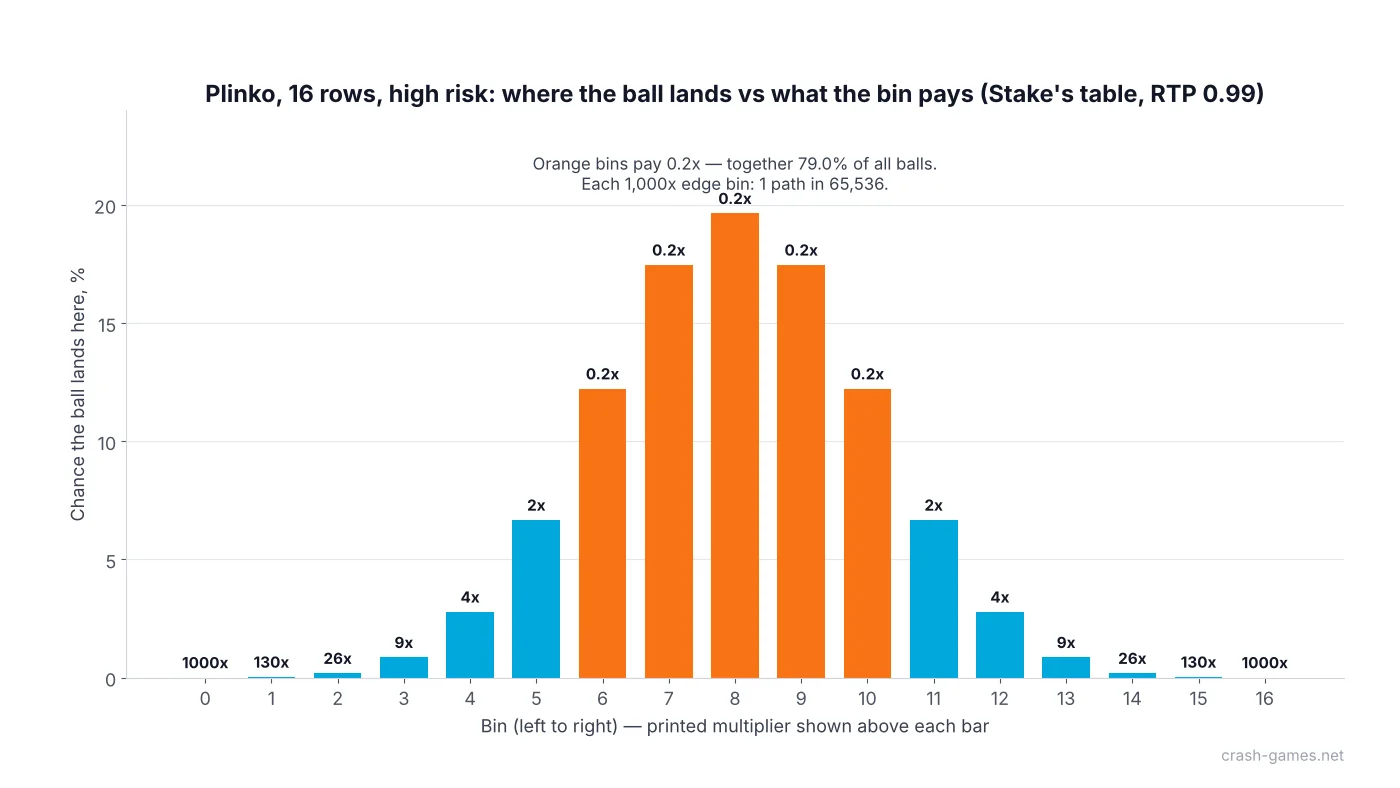
So on 16 rows the two 1,000x bins together arrive once per 32,768 balls on average, and the centre bin alone takes one ball in five.
The published tables, and the RTP check
Stake publishes its multiplier tables in the game. They are the reference set because the whole calculation can be reproduced: multiply each bin’s probability by its multiplier and add the row up.
8 rows
| Risk | Multipliers (left to right) | Weighted sum |
|---|---|---|
| Low | 5.6 · 2.1 · 1.1 · 1 · 0.5 · 1 · 1.1 · 2.1 · 5.6 | 0.990 |
| Medium | 13 · 3 · 1.3 · 0.7 · 0.4 · 0.7 · 1.3 · 3 · 13 | 0.989 |
| High | 29 · 4 · 1.5 · 0.3 · 0.2 · 0.3 · 1.5 · 4 · 29 | 0.991 |
16 rows
| Risk | Multipliers (left to right) | Weighted sum |
|---|---|---|
| Low | 16 · 9 · 2 · 1.4 · 1.4 · 1.2 · 1.1 · 1 · 0.5 · 1 · 1.1 · 1.2 · 1.4 · 1.4 · 2 · 9 · 16 | 0.990 |
| Medium | 110 · 41 · 10 · 5 · 3 · 1.5 · 1 · 0.5 · 0.3 · 0.5 · 1 · 1.5 · 3 · 5 · 10 · 41 · 110 | 0.990 |
| High | 1000 · 130 · 26 · 9 · 4 · 2 · 0.2 · 0.2 · 0.2 · 0.2 · 0.2 · 2 · 4 · 9 · 26 · 130 · 1000 | 0.990 |
Every row lands on 0.99 within rounding, which is the 1% house edge Stake states. A 100% table, such as Duel’s, has to sum to 1.00 by the same calculation; a 97% table sums to 0.97. You do not have to trust the label on the game card — you can add it up.
What the risk setting really does
The ball does not know which risk you chose. The path probabilities are identical in all three modes; only the printed multipliers move. High risk takes value out of the centre bins and piles it on the edges, which produces three numbers worth memorising for the 16-row high table:
- 79.0% of balls land in one of the five 0.2x bins. Four balls in five return a fifth of the stake.
- 21.0% of balls pay 2x or more.
- 0.42% of balls — one in 239 — reach 26x or higher, and one in 32,768 reaches 1,000x.
On 8 rows low risk the picture inverts: 72.7% of balls pay at least the stake back, 27.3% land in the 0.5x centre, and the 5.6x edges come once in 128 balls. Same expected value, opposite experience.
Rows are a resolution setting. More rows means more bins, a sharper centre and rarer edges, which is how the top multiplier climbs from 29x at 8 rows to 1,000x at 16 without the weighted sum moving off 0.99.
Provably fair: sixteen coin flips
At Duel and Stake the drop is computed before the animation. The server seed (committed by hash before the round), your client seed and a nonce go through HMAC-SHA256; the output is cut into one number per row; each number below 0.5 sends the ball left and each number above sends it right. Sixteen numbers, sixteen bounces, one bin. The animation then plays a path that ends where the maths already said it would. A “Plinko predictor” would need the server seed that is revealed only after you rotate it, which is to say it would need to predict a hash. The provably fair guide shows the verification; the predictor-app page covers the sales pitch.
A strategy framework that respects the maths
- Pick the risk setting by what you want a session to feel like. Low risk on 8 rows pays something back on 73% of balls and never more than 5.6x; high risk on 16 rows pays 0.2x on 79% of balls and occasionally 130x or 1,000x. The average is 0.99 of the stake in both.
- Autobet changes nothing except the number of stakes. 1,000 balls at 16 rows high gives a 3.0% chance of seeing at least one 1,000x bin; the expected return of those 1,000 balls is still 990 units per 1,000 wagered. If the 1,000x is the point of the session, know that the expected cost of looking for it is 1% of everything you drop.
- Budget for the 0.2x run, not the 1,000x hit. At high risk the ball lands in a 0.2x bin four times in five; twenty consecutive 0.2x results happen with probability 0.7920 ≈ 0.9%, so a 1,000-ball autobet will contain such runs. The bankroll guide explains sizing against streaks.
- Use the printed table, not the label. If an operator’s bins do not sum to the RTP it advertises, the table is the truth and the label is marketing.
- Prefer the higher printed RTP for the same setting. Duel’s 100% table returns the stake on average; the 99% tables cost one unit per hundred wagered; a 97% table costs three.
Where to play Plinko
Duel’s Plinko carries the 100% RTP badge of its Originals range; Stake’s is the 99% reference version whose tables appear above; 1win and the Spribe-supplied lobbies are compared on the where-to-play page, together with each operator’s restrictions.
| Casino | Version | RTP shown | Play |
|---|---|---|---|
| Duel | Duel Originals | 100% | Open Duel Plinko |
| 1win | Lobby version | See in-game info panel | Open 1win |
Availability, currency and bet limits depend on your jurisdiction and on each operator’s own rules.
FAQ
What is the RTP of Plinko?
100% at Duel, 99% at Stake and in BGaming’s version, 97% in Spribe’s version, as each publishes. You can verify any of them: multiply every bin’s probability, C(rows, k) ÷ 2^rows, by its printed multiplier and add the results.
Which Plinko setting has the best odds?
None. Rows and risk change the printed multipliers but not the ball’s path probabilities, and every published table at a given operator sums to the same RTP. High risk trades frequent small returns for rare large ones; low risk does the opposite.
How rare is the 1,000x bin?
On 16 rows there are 65,536 equally likely paths and exactly one leads to each edge bin, so a 1,000x result arrives once per 32,768 balls on average. Over 1,000 balls the chance of seeing at least one is about 3%.
Does the risk setting change where the ball goes?
No. The ball bounces left or right with equal probability at every peg regardless of the setting. Risk only changes the multipliers printed under the bins.
Can a Plinko predictor or bot know the next bin?
No. The path is computed from a server seed the casino committed to before the round, your client seed and a bet counter. Without the unrevealed server seed there is nothing to compute from.
Play responsibly
Plinko’s autobet will drop hundreds of balls a minute if you let it, and the low edge makes the drain slow enough to miss. Set a deposit and time limit before you start, never chase a loss, and stop when the session stops being fun. Play only if you are 18+ and gambling is legal where you are.
Free, confidential advice and self-exclusion tools are available at BeGambleAware.