
18+ only. Gambling involves risk. Play only with money you can afford to lose.
Affiliate disclosure: crash-games.net may earn a commission from the operators linked on this page. It does not change any number in this guide.
Updated: October 2026
“Originals” is the label crypto casinos put on the games they build in-house instead of licensing from a studio. Stake calls its set Stake Originals, Duel calls its set Duel Originals, and the same handful of formats sits at the core of both: Mines, Plinko, Dice, Limbo and Keno, usually next to a Crash game. Providers such as Spribe and BGaming ship their own versions of the same formats to ordinary casino lobbies.
They belong on a crash-game site for a simple reason: they are the same kind of object. Every one of them is a fixed-odds game where you choose your own variance, the result is settled by a provably fair seed pair rather than a reel strip, and the whole paytable can be written down as one formula. This hub explains that formula once, then sends you to the detailed page for each game.
The one formula behind every original
In a slot, the paytable is a list of symbol combinations that someone designed. In an original, the paytable is a calculation:
multiplier = RTP ÷ probability of winning
That is the entire engine. If an outcome happens 50% of the time, a fair game pays 2.00x for it. A game with a 1% house edge pays 0.99 ÷ 0.5 = 1.98x. A game with a 3% edge pays 1.94x. The game does not need to “know” how you play; whatever win chance you build with the controls, it divides the RTP by that chance and shows you the result.
| Game | What you choose | Win chance comes from | Multiplier (fair) |
|---|---|---|---|
| Mines | Number of mines on a 5×5 grid, how many tiles to reveal | C(safe tiles, picks) ÷ C(25, picks) | 1 ÷ that probability |
| Plinko | Rows (8–16) and a risk setting | Binomial path: C(rows, bin) ÷ 2rows | Published per bin; the weighted sum equals the RTP |
| Dice | Roll over or under a number from 0.00 to 100.00 | The width of the winning range | 1 ÷ chance |
| Limbo | A target multiplier | 1 ÷ target | The target itself |
| Keno | 1–10 numbers out of 40, a risk setting | Hypergeometric: how many of your numbers are among the 10 drawn | Published per hit count |
Three worked examples, all with a 1% house edge:
- Dice, roll under 50.00: chance 50%, multiplier 0.99 ÷ 0.50 = 1.98x.
- Mines, 3 mines, reveal 3 tiles: chance (22 × 21 × 20) ÷ (25 × 24 × 23) = 66.96%, multiplier 0.99 ÷ 0.6696 = 1.48x.
- Limbo, target 10x: chance 0.99 ÷ 10 = 9.9%, and the payout is the target, 10x.
Set the edge to zero and the same three bets become 2.00x, 1.49x and exactly 10%. That is the whole difference between a 99% and a 100% original.
What the RTP number actually says
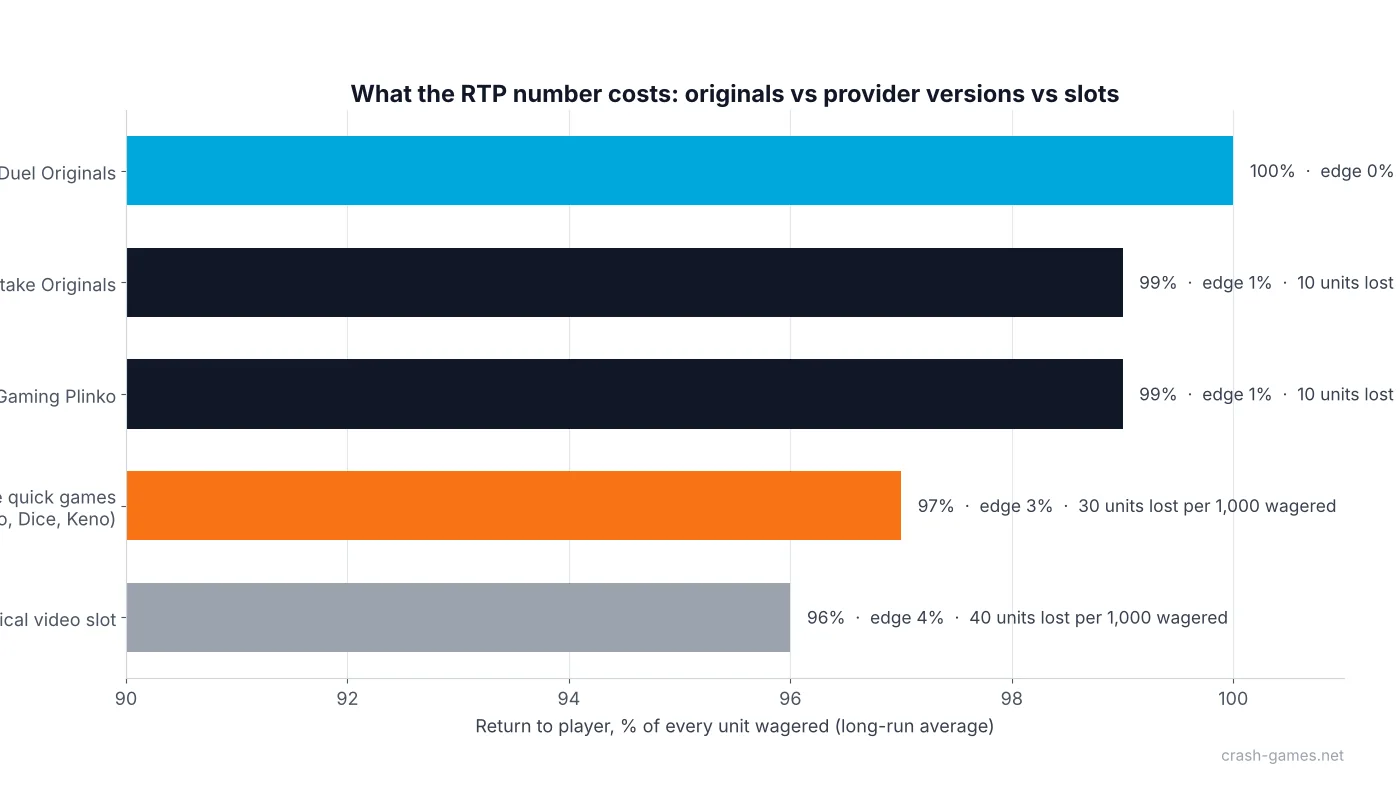
RTP is the share of every unit wagered that the game returns to players over the long run. The three figures you will meet in this family:
| RTP | House edge | Expected cost per 1,000 units wagered | Where you see it |
|---|---|---|---|
| 100% | 0% | 0 | Duel Originals (labelled “Zero Edge” on every game card) |
| 99% | 1% | 10 | Stake Originals; BGaming’s Plinko publishes the same figure |
| 97% | 3% | 30 | Spribe’s Mines, Plinko, Dice and Keno, as supplied to ordinary lobbies |
Two things the number does not say. It says nothing about the next hundred rounds, because variance dwarfs the edge over any session you will actually sit through. And a 100% RTP does not make the game safe: a zero-edge game is a coin that is fair, not a coin that pays you. Starting with 100 units and betting 1 unit at even money, you bust before doubling exactly half the time at 100%, 88% of the time at 99%, and 99.75% of the time at 97%. The full working, including why “stop on profit” cannot manufacture an edge, is on the 100% RTP page.
Mines
A 5×5 grid hides 1 to 24 mines. Reveal tiles one at a time; each safe tile multiplies the stake, each revealed mine ends the round at zero, and you can cash out after any safe tile. The multiplier after k safe picks with M mines is the RTP divided by C(25 − M, k) ÷ C(25, k).
The number that surprises most players: with 1 mine and a single pick, the win chance is 96% and the payout is only 1.03x at 99% RTP. With 24 mines and a single pick, the chance is 4% and the payout is 24.75x. Both bets have the same expected value. The mines slider is a variance dial, nothing else. Full Mines maths, tables and strategy framework →
Plinko
A ball falls through 8 to 16 rows of pegs, bouncing left or right at each one, and lands in a bin with a printed multiplier. The landing bin follows a binomial distribution, so the centre is common and the edges are rare: on 16 rows the two 1,000x edge bins together come up once per 32,768 balls, while on the high-risk setting 79% of balls land in a 0.2x bin. Full Plinko probabilities, Stake’s published tables and the RTP check →
Dice
The game draws a number from 0.00 to 100.00. You bet it lands over or under a line you set, and the multiplier is the RTP divided by the width of your winning range. Chance 95% pays 1.04x; chance 1% pays 99x; chance 0.01% pays 9,900x at 99% RTP. Dice is where most “systems” are tested and where the martingale fails most visibly, because the slider makes the arithmetic impossible to hide. Full Dice maths and the martingale breakdown →
Limbo
Name a target multiplier; the game draws a result; if the result is at least your target, you win the target. The chance of winning is the RTP divided by the target, which is exactly the curve a crash game draws on screen every round. Limbo is a crash game with the animation removed and the cashout decision made in advance, so it is the cleanest place to see what a crash multiplier is worth. Full Limbo maths and the comparison with crash →
Keno
Pick 1 to 10 numbers from 40; the game draws 10. The probability of matching h of your numbers is hypergeometric: C(picks, h) × C(40 − picks, 10 − h) ÷ C(40, 10). With 5 picks you match nothing 21.7% of the time and all five once in 2,611 rounds. With 10 picks, matching all ten happens once in 847,660,528 rounds, which is why the top prize can be printed in four or five figures without troubling the operator. The paytables differ by risk setting and by casino, so the RTP has to be read off the in-game rules screen rather than assumed; the formula above lets you check it yourself.
Provably fair, in one paragraph
Each round is computed from three inputs: a server seed the casino commits to in advance by showing you its hash, a client seed you can edit, and a nonce that increases by one each bet. Those three go through HMAC-SHA256, the output bytes become numbers between 0 and 1, and those numbers place the mines, bounce the Plinko ball, roll the dice or set the Limbo result. After you rotate seeds the old server seed is revealed, and you can recompute every past round. The practical consequence is the one that matters for your money: the result is fixed before you click, by inputs no outside app can see. Our provably fair guide walks through a verification step by step, and the predictor-app page explains why “Mines predictor” and “Plinko signal” bots are selling something that cannot exist.
Where the originals are played
Duel runs twelve Originals, every one of them tagged 100% RTP, which makes it the reference point for zero-edge play. Stake has the largest set at a 1% edge and the best-documented fairness tooling. 1win carries Mines- and Plinko-type titles in a lobby built for Russian-speaking markets. Vavada and SpinBetter carry Spribe’s 97% versions next to Aviator. Operator by operator, including restrictions, the comparison is on the where-to-play page.
FAQ
What are casino originals?
Games a casino builds and runs itself instead of licensing from a studio. Stake Originals and Duel Originals are the best-known sets; the core formats are Mines, Plinko, Dice, Limbo, Keno and Crash. Providers such as Spribe and BGaming sell versions of the same formats to other casinos.
Why do originals have a higher RTP than slots?
Because the operator keeps the whole margin and the game costs almost nothing to run, so it can price the edge at 1% (Stake) or even 0% (Duel) and still earn on the rest of its lobby. A licensed slot has to pay the studio and typically returns 94–97%.
Is a 100% RTP game free money?
No. 100% RTP means your expected result is exactly zero, not positive. Variance still moves your balance every round, and with a finite bankroll against a casino that effectively has an infinite one, long enough play ends at zero with certainty. The 100% RTP page on this site shows the ruin figures.
Which original has the best odds?
At the same operator they all have the same expected value, because every one of them pays RTP divided by win chance. The difference between Mines, Plinko, Dice and Limbo is the shape of the variance you buy, not the price of it. Between operators, the RTP figure on the game card is the only number that changes the price: 100% at Duel, 99% at Stake, 97% for Spribe versions.
Can a predictor app beat Mines or Plinko?
No. The result of each round is computed from a server seed the casino committed to before the round, your client seed and a counter. No app has the server seed, so no app can know the result. Verification is possible only after the seed is revealed, which is after the round.
Play responsibly
Originals are fast. A Dice round takes under a second, Mines and Plinko have autobet modes that run hundreds of rounds unattended, and the low house edge makes losses feel slower than they are. Set a deposit and time limit before you start, never chase a loss, and stop when the session stops being fun. Play only if you are 18+ and gambling is legal where you are.
Free, confidential advice and self-exclusion tools are available at BeGambleAware.