
18+ only. Gambling involves risk. Play only with money you can afford to lose.
Affiliate disclosure: crash-games.net may earn a commission from the operators linked on this page. It does not change any number in this breakdown.
Updated: October 2026
Mines is the simplest original to describe and the one players misunderstand most. A 5×5 grid hides a number of mines you choose; you turn tiles over one at a time; every safe tile raises the multiplier; the first mine ends the round at zero; you may cash out after any safe tile. There is no reel, no bonus round and no hidden paytable. The entire game is one probability calculation, and this page writes it out.
Specification at a glance
| Item | Value |
|---|---|
| Grid | 25 tiles (5×5) |
| Mines | 1 to 24, chosen before the round |
| Decisions | Number of mines; after each safe tile, reveal another or cash out |
| Multiplier after k safe picks | RTP ÷ [C(25 − M, k) ÷ C(25, k)], where M is the number of mines |
| RTP | 100% Duel Originals · 99% Stake Originals · 97% Spribe’s Mines (as published by each) |
| Fairness | Provably fair at Duel and Stake (server seed, client seed, nonce); Spribe’s version is also provably fair at the operators that enable it |
| Theoretical maximum | C(25, M) × RTP for clearing every safe tile: 25x with 1 mine, 2,300x with 3, 53,130x with 5, 3,268,760x with 10 — subject to each operator’s maximum payout |
The formula, and why it is exact
With M mines there are 25 − M safe tiles. The probability that your first k picks are all safe is the number of ways to choose k safe tiles divided by the number of ways to choose any k tiles:
P(k safe) = C(25 − M, k) ÷ C(25, k)
Written as a product it is easier to feel: with 3 mines, the first tile is safe with probability 22/25, the second 21/24, the third 20/23. Multiply them and you get 0.6696. A fair game would pay 1 ÷ 0.6696 = 1.4935x for three safe tiles; a 1% edge pays 0.99 ÷ 0.6696 = 1.4786x, which is the 1.48x printed on Stake’s grid.
Because the formula is public, you can check any casino’s Mines against it in a minute. Pick a configuration, read the multiplier shown, multiply it by the win probability from the table below, and you get the RTP that operator is actually running.
Multiplier tables
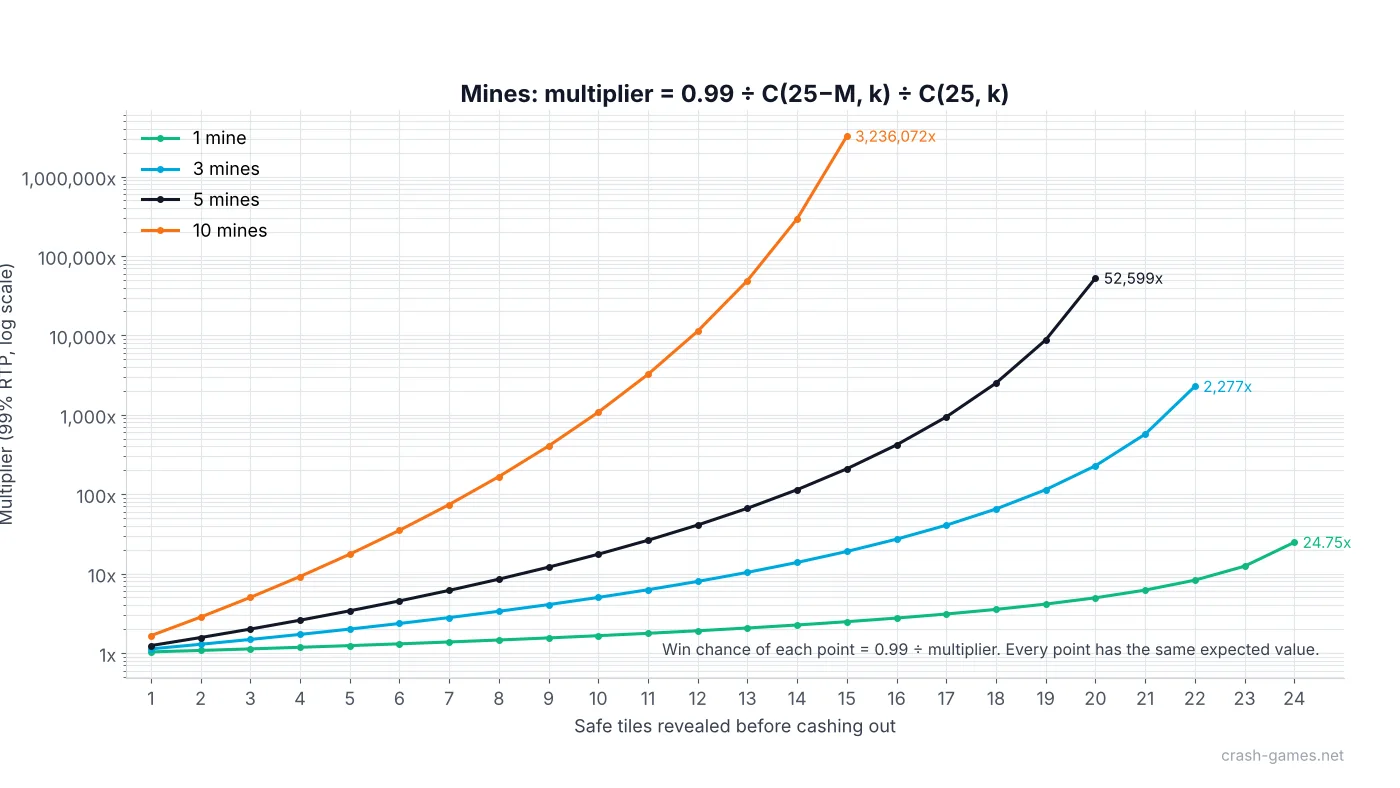
Fair value is the 100% RTP figure, which is what a Duel grid shows. The 99% column is the Stake figure; the 97% column is Spribe’s. All numbers are rounded to two decimals; the games round the same way.
1 mine (24 safe tiles)
| Safe picks | Win chance | 100% | 99% | 97% |
|---|---|---|---|---|
| 1 | 96.00% | 1.04x | 1.03x | 1.01x |
| 2 | 92.00% | 1.09x | 1.08x | 1.05x |
| 3 | 88.00% | 1.14x | 1.13x | 1.10x |
| 4 | 84.00% | 1.19x | 1.18x | 1.15x |
| 5 | 80.00% | 1.25x | 1.24x | 1.21x |
| 6 | 76.00% | 1.32x | 1.30x | 1.28x |
| 24 (all) | 4.00% | 25.00x | 24.75x | 24.25x |
3 mines (22 safe tiles)
| Safe picks | Win chance | 100% | 99% | 97% |
|---|---|---|---|---|
| 1 | 88.00% | 1.14x | 1.13x | 1.10x |
| 2 | 77.00% | 1.30x | 1.29x | 1.26x |
| 3 | 66.96% | 1.49x | 1.48x | 1.45x |
| 4 | 57.83% | 1.73x | 1.71x | 1.68x |
| 5 | 49.57% | 2.02x | 2.00x | 1.96x |
| 6 | 42.13% | 2.37x | 2.35x | 2.30x |
| 22 (all) | 0.043% | 2,300x | 2,277x | 2,231x |
5 mines (20 safe tiles)
| Safe picks | Win chance | 100% | 99% | 97% |
|---|---|---|---|---|
| 1 | 80.00% | 1.25x | 1.24x | 1.21x |
| 2 | 63.33% | 1.58x | 1.56x | 1.53x |
| 3 | 49.57% | 2.02x | 2.00x | 1.96x |
| 4 | 38.30% | 2.61x | 2.58x | 2.53x |
| 5 | 29.18% | 3.43x | 3.39x | 3.32x |
| 6 | 21.89% | 4.57x | 4.52x | 4.43x |
| 20 (all) | 0.0019% | 53,130x | 52,599x | 51,536x |
10 mines (15 safe tiles)
| Safe picks | Win chance | 100% | 99% | 97% |
|---|---|---|---|---|
| 1 | 60.00% | 1.67x | 1.65x | 1.62x |
| 2 | 35.00% | 2.86x | 2.83x | 2.77x |
| 3 | 19.78% | 5.05x | 5.00x | 4.90x |
| 4 | 10.79% | 9.27x | 9.17x | 8.99x |
| 5 | 5.65% | 17.69x | 17.52x | 17.16x |
| 6 | 2.83% | 35.38x | 35.03x | 34.32x |
24 mines (1 safe tile)
One pick, 4.00% chance: 25.00x at 100%, 24.75x at 99%, 24.25x at 97%. It is the same bet as clearing a 1-mine board in a single round, compressed into one click.
Every configuration costs the same
Look down any 99% column and multiply each multiplier by its win chance. 1.03125 × 0.96 = 0.99. 1.4786 × 0.6696 = 0.99. 24.75 × 0.04 = 0.99. Every cell in every table returns the same 0.99 of the stake on average. The mines slider and the cashout point change how you lose the 1% (slowly in tiny bites or rarely in big ones), never whether.
There is a second consequence that is less obvious. Suppose you have revealed k safe tiles and are deciding whether to reveal one more. The next tile is safe with probability (25 − M − k) ÷ (25 − k), and if it is, the multiplier rises by exactly the inverse of that. The expected value of continuing is therefore identical to the expected value of cashing out now. The house edge was priced in when you placed the bet; from then on, every “reveal or cash out” decision is a pure variance decision with zero effect on your long-run return. There is no correct tile count to stop at, only the amount of swing you are willing to take on this particular stake.
The “safe grind” that is not safe
The most common Mines plan on streams and in Telegram groups is 1 mine, 1 pick, repeat: a 96% win rate feels like a steady income. Here is what the arithmetic says per 1-unit bet:
| RTP | Payout on the 96% | Profit per win | Break-even win rate | Average result after 1,000 bets from 100 units |
|---|---|---|---|---|
| 100% | 1.0417x | +0.0417 | 96.00% | 100 (unchanged) |
| 99% | 1.0313x | +0.0313 | 96.97% | 90 |
| 97% | 1.0104x | +0.0104 | 98.97% | 70 |
At 99% you need to win 96.97% of the time to stand still and you actually win 96%. The 1-in-25 loss costs the whole stake, which is 32 wins’ worth of profit. The grind does not reduce the house edge; it only makes each loss arrive after a long enough run of wins that it feels like bad luck rather than the price.
Provably fair: how the mines are placed
At Duel and Stake the positions are not drawn when you click. Before the round, the casino has already committed to a server seed by showing you its SHA-256 hash; you hold a client seed you may change; a nonce counts your bets. HMAC-SHA256 of those inputs produces a stream of bytes, the bytes become numbers between 0 and 1, and those numbers shuffle the 25 positions. The first M positions of the shuffle are the mines. Reveal order has no effect on where they are.
What this means for the “Mines predictor” apps and Telegram “signals” that rank for this game: the only unknown input is the server seed, which is exactly the input they do not have. A predictor can show you a grid with confidence; it cannot have computed it from anything. Our predictor-app page covers the usual sales pitch and the provably fair guide shows how to verify a round yourself once the seed is revealed.
A strategy framework that respects the maths
- Choose the mines count by the win rate you can live with, not by the multiplier. 1–3 mines and 1–3 picks keeps rounds above 65% win chance; 5 mines and 5 picks is a 29% proposition; 10 mines and 4 picks is 11%. Decide first how often you are prepared to see zero.
- Treat the cashout point as a variance setting. It does not change the long-run return, so pick it in advance and keep it; changing it mid-round after a near miss is tilt, not strategy. The stop-loss and stop-win rules on this site apply unchanged.
- Autobet multiplies exposure, not edge. 500 rounds at 1 mine, 1 pick is 500 stakes with an expected cost of 1% each at 99%. “Stop on profit” and “stop on loss” settings cap the session, which is useful; they do not improve the average, which is impossible.
- Size the stake for the losing streak the configuration implies. At 5 mines and 5 picks you lose 71% of rounds; ten losses in a row happen with probability 0.7110 ≈ 3.3%, roughly once per 30 such sequences. The bankroll guide has the arithmetic.
- Prefer the operator with the higher printed RTP for the same configuration. That is the only lever that changes the price: a 3-mine, 3-pick round pays 1.49x at Duel, 1.48x at Stake and 1.45x in Spribe’s version, for the same 66.96% chance.
Where to play Mines
Duel’s Mines carries the 100% RTP badge of its Originals range and is linked below; Stake’s is the 99% reference version; 1win and the Spribe-supplied lobbies at Vavada and SpinBetter are compared on the where-to-play page, together with each operator’s restrictions.
| Casino | Version | RTP shown | Play |
|---|---|---|---|
| Duel | Duel Originals | 100% | Open Duel Mines |
| 1win | Lobby version | See in-game info panel | Open 1win |
Availability, currency and bet limits depend on your jurisdiction and on each operator’s own rules.
FAQ
What is the RTP of Mines?
It depends on who runs it: 100% at Duel, 99% at Stake and 97% in Spribe’s version. The figure is the same for every mines count and every cashout point at a given operator, because the multiplier is always RTP divided by the win probability.
What is the best number of mines?
There is no best number for expected value; every configuration returns the same share of the stake over time. Fewer mines means frequent small wins, more mines means rare large ones. Choose by the loss frequency you are comfortable with.
Does cashing out early improve my odds?
No. After any safe tile, continuing and cashing out have identical expected value, because the next multiplier step is exactly the inverse of the next tile’s safety probability. Cashing out early lowers variance, not the house edge.
Do Mines predictor apps work?
No. Mine positions come from a server seed the casino committed to before the round plus your client seed and a counter. The server seed is not available to any outside app until after it is rotated, so a predictor has nothing to predict from.
What is the maximum multiplier in Mines?
Clearing every safe tile pays C(25, M) times the RTP: 25x with one mine, 2,300x with three, 53,130x with five and 3,268,760x with ten at 100% RTP. Operators cap the actual payout at their maximum win, so check that limit before chasing the top of the table.
Is the 1-mine, 1-pick grind profitable?
Only at exactly 100% RTP, where it breaks even. At 99% you need a 96.97% win rate to break even and the real rate is 96%; over 1,000 one-unit bets the average result is a loss of 10 units. At 97% the average loss is 30 units.
Play responsibly
Mines rounds last seconds and the autobet mode will run them for you unattended. Set a deposit and time limit before you start, never chase a loss, and stop when the session stops being fun. Play only if you are 18+ and gambling is legal where you are.
Free, confidential advice and self-exclusion tools are available at BeGambleAware.