
18+ only. Gambling involves risk. Play only with money you can afford to lose.
Affiliate disclosure: crash-games.net may earn a commission from the operators linked on this page. It does not change any number in this breakdown.
Updated: October 2026
Dice is the original with no theme at all. The game draws a number between 0.00 and 100.00; you bet it lands over or under a line you place; the multiplier is the RTP divided by the width of your winning range. That is the complete rule set, which is why Dice is where every betting “system” ends up being tested and where the arithmetic of the house edge is hardest to hide. This page sets out the formula, the table it produces, and what happens to the most popular progression when it meets a bankroll limit.
Specification at a glance
| Item | Value |
|---|---|
| Result range | 0.00 to 100.00 in steps of 0.01 (10,001 possible outcomes) |
| Bet types | Roll over or roll under a line you set |
| Win chance | The width of the winning range, from 0.01% to 98% at Stake |
| Multiplier | RTP ÷ win chance |
| Top multiplier | 9,900x at 0.01% chance and 99% RTP (10,000x at 100%) |
| RTP | 100% Duel Originals · 99% Stake Originals · 97% Spribe’s Dice (as published by each) |
| Fairness | Provably fair: one random number per roll, scaled to the 0.00–100.00 range |
The slider is the whole game
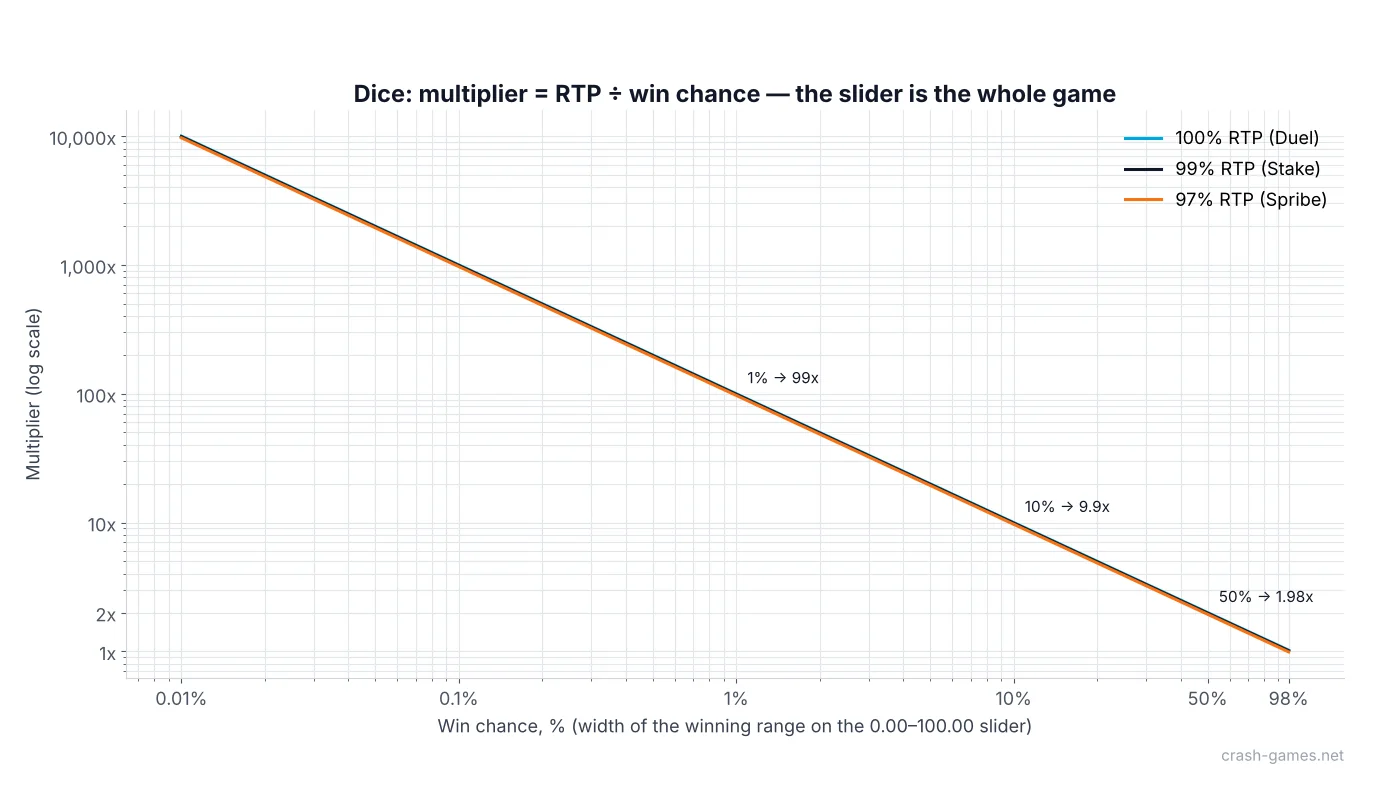
Move the line to 50.00 and bet under: you win when the roll is below 50.00, which is half the range, so a 99% game pays 0.99 ÷ 0.50 = 1.98x. Move it to 95.00: the range is 95% of the outcomes and the payout is 1.0421x. Move it to 1.00: a 1% range pays 99x. Every position on the slider is a different bet with the same price.
| Win chance | 100% RTP | 99% RTP | 97% RTP |
|---|---|---|---|
| 98% | 1.0204x | 1.0102x | 0.9898x |
| 95% | 1.0526x | 1.0421x | 1.0211x |
| 90% | 1.1111x | 1.1000x | 1.0778x |
| 75% | 1.3333x | 1.3200x | 1.2933x |
| 50% | 2.0000x | 1.9800x | 1.9400x |
| 25% | 4.0000x | 3.9600x | 3.8800x |
| 10% | 10.00x | 9.90x | 9.70x |
| 5% | 20.00x | 19.80x | 19.40x |
| 1% | 100.0x | 99.0x | 97.0x |
| 0.5% | 200.0x | 198.0x | 194.0x |
| 0.1% | 1,000x | 990x | 970x |
| 0.01% | 10,000x | 9,900x | 9,700x |
One row deserves a second look. At 97% RTP a 98% chance pays 0.9898x: you win 98 rolls in 100 and still lose money on the winning rolls. The table is not broken; the edge is simply larger than the profit on a near-certain bet. A sensible operator stops the slider before that point; check where it stops in the version you open, because the table above is what any position pays.
Why the martingale fails on Dice specifically
The martingale is the oldest Dice plan: bet at roughly even money, double after every loss, return to the base stake after a win. Each winning sequence nets exactly one base unit, so the plan looks like a machine that prints units. The machine has two parts the sales pitch leaves out.
The streak arrives on schedule. At 49.5% (1.98x, 99% RTP) a losing roll happens 50.5% of the time. Ten losses in a row have probability 0.50510 ≈ 0.108%, roughly once every 927 sequences. A player grinding 1,000 base-unit sequences in a session should expect to meet one.
The streak costs 2n − 1 units. After ten doublings the eleventh bet is 1,024 units and the sequence has already risked 1,023. A bankroll of 1,000 units, or a table maximum below 1,024, ends the progression there with a 1,023-unit loss against the roughly 927 single units the plan collected on the way. The expected value of the whole exercise is the house edge times the total wagered, exactly as it was for flat bets, because no sequence of bets at negative expectation can add up to positive expectation. The chasing-losses page covers the psychology; this is the arithmetic.
| Consecutive losses | Probability (49.5% win) | Next bet (units) | Already lost (units) |
|---|---|---|---|
| 5 | 3.28% | 32 | 31 |
| 7 | 0.84% | 128 | 127 |
| 10 | 0.108% | 1,024 | 1,023 |
| 12 | 0.027% | 4,096 | 4,095 |
| 15 | 0.0035% | 32,768 | 32,767 |
At 100% RTP the plan is no longer negative; it is exactly zero. The streak still comes, the bankroll still ends it, and the units collected before it are, on average, precisely what the streak takes away. Zero edge removes the slow leak; it does not create a pump.
Provably fair: one number, scaled
At Duel and Stake the roll is produced before you see it. The server seed (committed by hash), your client seed and the bet nonce go through HMAC-SHA256; the first bytes of the output become a number between 0 and 1; that number is multiplied by 10,001 and divided by 100 to give a result from 0.00 to 100.00. Because the inputs are fixed before the roll, no “Dice predictor” has anything to work with until the server seed is revealed, which happens only after you rotate it. The provably fair guide walks through a verification.
A strategy framework that respects the maths
- Treat the slider as a variance dial. 95% chance means losing one roll in twenty and gaining about 4% on each win; 10% chance means losing nine rolls in ten and gaining 9.9x on the tenth. The expected result is the same 0.99 per unit at either end.
- No progression changes the price. Martingale, Fibonacci, d’Alembert and “increase on win” all have expected value equal to the house edge times total turnover. What they change is when the loss lands and how large it is when it does.
- Autobet with stop limits is a session tool, not an edge. Stop-on-loss and stop-on-profit cap exposure, which is sensible. They do not alter the average, which the 100% RTP page shows in detail.
- Size the stake for the losing streak your chance implies. At 49.5% a ten-loss streak is routine over a long session; at 25% a ten-loss streak has probability 0.7510 ≈ 5.6%. The bankroll guide has the arithmetic.
- Read the RTP off the game, then compare. The same 50% roll pays 2.00x at Duel, 1.98x at Stake and 1.94x in a 97% version. That spread is the only thing that changes your long-run result.
Where to play Dice
Duel’s Dice carries the 100% RTP badge of its Originals range; Stake’s is the 99% reference version. Other lobbies and each operator’s restrictions are compared on the where-to-play page.
| Casino | Version | RTP shown | Play |
|---|---|---|---|
| Duel | Duel Originals | 100% | Open Duel Dice |
Availability, currency and bet limits depend on your jurisdiction and on each operator’s own rules.
FAQ
What is the RTP of casino Dice?
100% at Duel, 99% at Stake and 97% in Spribe’s version, as published by each. The figure is the same at every slider position, because the multiplier is always RTP divided by win chance.
Is roll over better than roll under?
No. Both are the same bet mirrored: a 30% range pays the same multiplier whether it sits at the bottom or the top of the 0.00–100.00 scale.
Does the martingale work on Dice?
No. Doubling after losses nets one unit per winning sequence, but a losing streak long enough to exhaust the bankroll or hit the bet limit arrives with predictable frequency: ten losses in a row at 49.5% happen about once per 927 sequences and cost 1,023 units. The expected value stays equal to the house edge times total turnover.
What is the highest Dice multiplier?
9,900x at 0.01% win chance on a 99% game, 10,000x at 100%. Operators may cap the maximum payout below that in money terms; check the limit before betting at the bottom of the slider.
Can a Dice predictor know the next roll?
No. The roll is computed from a server seed the casino committed to before the round, your client seed and a bet counter. Until the server seed is revealed, after rotation, there is nothing for an app to compute from.
Play responsibly
A Dice roll takes well under a second and the autobet mode will place thousands of them unattended. Set a deposit and time limit before you start, never chase a loss, and stop when the session stops being fun. Play only if you are 18+ and gambling is legal where you are.
Free, confidential advice and self-exclusion tools are available at BeGambleAware.