
18+ only. Gambling involves risk. Play only with money you can afford to lose.
Affiliate disclosure: crash-games.net may earn a commission from the operators linked on this page. It does not change any number in this breakdown.
Updated: October 2026
Duel prints “100% RTP” on every one of its twelve Originals and labels them “Zero Edge”. The claim is unusual enough that it deserves a page of its own, because it is both true in the sense the maths allows and misread in the sense players want. A 100% RTP game takes nothing from you on average. It also cannot give you anything on average, and it can still take everything. This page sets out what the number does, what it does not do, and how the operator can afford to print it.
What RTP is
Return to player is the share of every unit wagered that the game returns over the long run. It is a long-run average over a very large number of rounds, and it is the only price tag a casino game has.
| RTP | House edge | Expected result per 1,000 units wagered | Typical examples |
|---|---|---|---|
| 100% | 0% | 0 | Duel Originals |
| 99% | 1% | −10 | Stake Originals, BGaming’s Plinko |
| 97% | 3% | −30 | Aviator, Spribe’s Mines, Plinko, Dice and Keno |
| 96% | 4% | −40 | A typical video slot |
In the originals the number is not a label someone chose; it is built into the payout formula. Every one of these games pays RTP ÷ win chance, so a 100% game pays exactly the fair odds of whatever bet you construct: 2.00x for a 50% Dice roll, 1.0417x for a one-mine, one-pick Mines round, 10x for a 10% Limbo target. The formulas for each game are on the originals hub.
What zero edge does to your balance
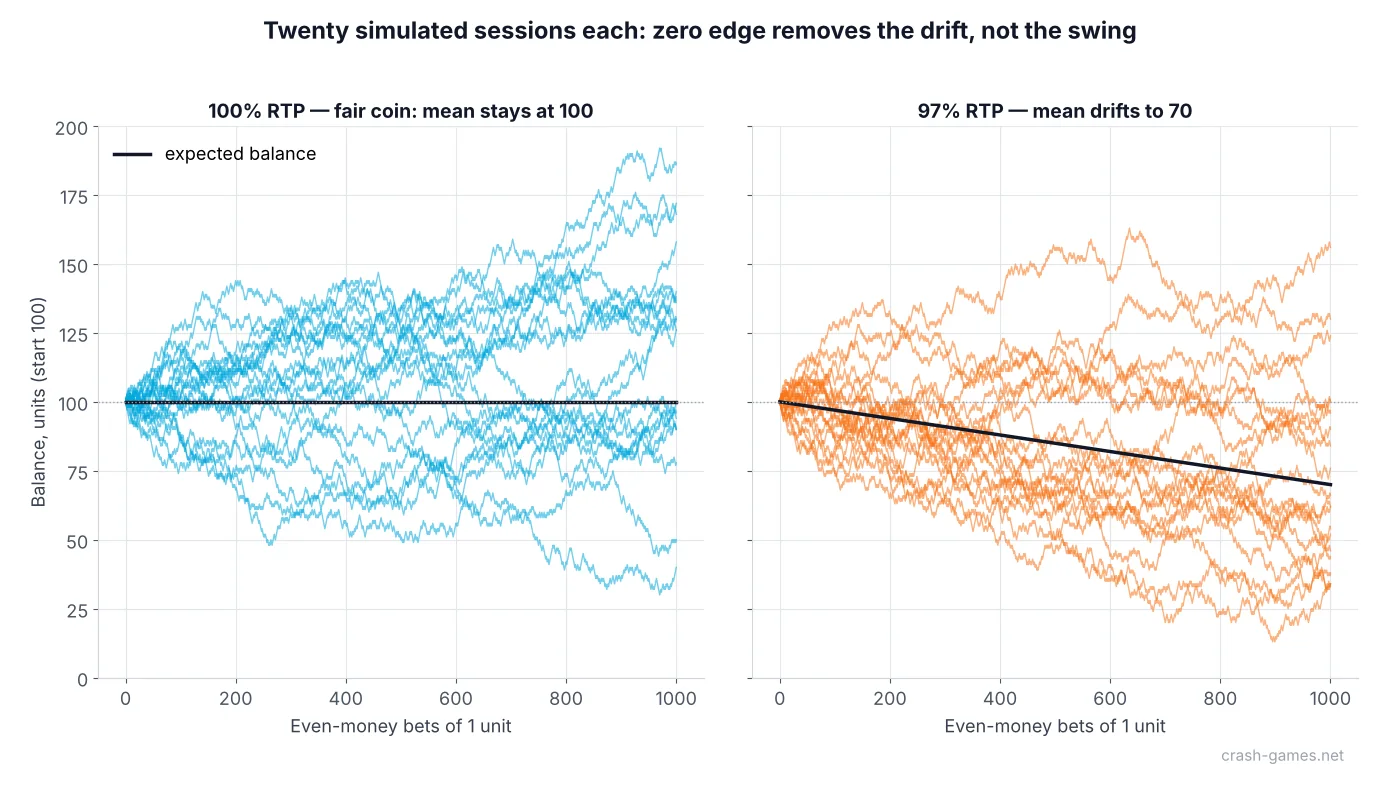
With no edge your balance is a fair random walk: on average it goes nowhere, and in practice it goes somewhere every round. The expected value is zero; the variance is not. The standard way to see what that means is the gambler’s ruin problem: start with a bankroll, bet a fixed unit at even money, and stop at a target or at zero.
| Start 100 units, bet 1 unit at even money | 100% RTP | 99% RTP | 97% RTP |
|---|---|---|---|
| Chance of busting before reaching 110 | 9.1% | 20.4% | 45.2% |
| Chance of busting before reaching 200 | 50.0% | 88.1% | 99.75% |
| Average balance after 1,000 bets (no stop) | 100 | 90 | 70 |
Read the first two rows together. At 100% RTP the chance of doubling a bankroll before losing it is exactly a coin flip, because the game is exactly fair. At 99% it is one chance in eight; at 97% it is one in four hundred. The edge is small per round and enormous over a target, because the target takes hundreds of rounds to reach and the edge is charged on every one of them.
The third row is the one autobet players should keep in view. A thousand one-unit bets at 99% cost ten units on average; at 97% thirty; at 100% nothing. That is the entire advantage of a zero-edge game, and it is real: the slow leak is gone. What has not gone is the swing. Keep playing a fair game with a finite bankroll against a counterparty with an effectively unlimited one, and the probability of eventually reaching zero is 1. The only question is when.
Why “stop on profit” cannot create an edge
The autobet panels on Mines, Plinko, Dice and Limbo offer stop-on-profit and stop-on-loss limits, and a popular plan is to run tiny stakes with a small profit target, bank it, and restart. It feels like harvesting. The maths says otherwise, and the reason has a name: the optional stopping theorem. In a fair game, no stopping rule that depends only on what has happened so far can change the expected result from zero. In a game with an edge, no stopping rule can change the expected result from the edge times the total you wagered before stopping.
The intuition is the “bust before 110” row above. Stopping at +10 units works 91% of the time at 100% RTP — and the other 9% of the time you lose 100 units. Ten wins of 10 units are exactly cancelled by one loss of 100. The profit target does not remove the losing branch; it just makes it rare enough that a short record of sessions looks like a system. At 99% the losing branch is twice as likely and the ten wins no longer cover it, which is the 1% showing up where it always does: in the total.
How an operator affords zero edge
A casino that earns nothing on a game still runs it if the game brings players to the games that do earn. Duel’s lobby is the Originals plus third-party slots, live tables and a sportsbook, and those carry ordinary margins; the Originals are the reason to open the site. Three things follow for a player:
- Zero edge is per game, not per account. The moment you move to a slot, the price is that slot’s RTP. A 96% slot costs forty units per thousand wagered, which is the same money the Originals were not charging.
- Rakeback is paid where there is rake. Duel’s rakeback programme returns a share of the house’s take on eligible games, and the published terms attach it to third-party games such as slots and live casino. A zero-edge game has no take to share, so do not expect rakeback on Mines or Limbo; read the current terms before counting on it anywhere.
- The casino still wins on variance. Not on average, but in the gambler’s-ruin sense above: it has more units than you and never stops. Being fair is not the same as being safe.
Reading the number correctly on any game card
- Check that the table adds up. For Plinko, multiply each bin’s probability by its multiplier and sum; for Mines, Dice and Limbo, multiply the shown multiplier by the win chance. If a 100% game is really 100%, the product is 1.00 for every configuration. The Plinko page shows the full calculation for Stake’s 99% tables.
- Check the maximum payout. A 100% game with a maximum win below the top of its own table is not 100% at the top of the table. High-target Limbo and all-tiles Mines are where caps bite.
- Compare like with like. The same 50% Dice roll pays 2.00x at Duel, 1.98x at Stake and 1.94x in a 97% version. That spread, and nothing else, is what the RTP decides.
- Remember what the number cannot tell you. It says nothing about the next hundred rounds. A 100% game can lose a hundred rounds in a row at the same odds as a 99% game; the difference shows up in the average, over a sample far larger than a session.
Where the 100% games are
At the time of writing, Duel is the operator running a full set of zero-edge originals: Dice, Blackjack, Plinko, Crash, Mines, Beef, Keno, Castle Roulette, Video Poker, Groomer’s Van, Rock Paper Scissors and Limbo, all tagged 100% RTP in its lobby. Its restrictions and the 99% and 97% alternatives are compared on the where-to-play page.
| Casino | Games at 100% | Play |
|---|---|---|
| Duel | 12 Originals (verified by screenshot, 12 October 2026) | Open Duel Originals |
Availability, currency and bet limits depend on your jurisdiction and on each operator’s own rules.
FAQ
Does 100% RTP mean I can’t lose?
No. It means your average result over a very large number of rounds is zero. Any single session can end anywhere, and with a finite bankroll against a casino that never stops, playing long enough ends at zero with certainty. Starting with 100 units and betting 1 at even money, you bust before doubling exactly half the time.
Can I make money on a 100% RTP game with stop-on-profit?
No. In a fair game no stopping rule changes the expected result from zero: the rare sessions where you hit the loss limit cost exactly what the frequent small profits collect. In a game with an edge, the expected result is the edge times everything you wagered before stopping.
How can a casino run games with no house edge?
The zero-edge games bring players to a lobby whose slots, live tables and sportsbook carry normal margins, and those pay for the site. The casino also keeps the structural advantage of a far larger bankroll than any player.
Is 100% RTP really better than 99%?
Yes, by exactly one unit per hundred wagered. Over 1,000 one-unit bets the average result is 0 at 100% and −10 at 99%. The chance of doubling a 100-unit bankroll before losing it is 50% at 100% RTP and 12% at 99%.
Does rakeback apply to 100% RTP games?
Rakeback returns part of the house’s take, and a zero-edge game has none to return. Duel’s published terms attach rakeback to eligible third-party games such as slots and live casino; check the current terms before relying on it for any game.
Play responsibly
A fair game is still a game you can lose everything in, and the absence of a house edge makes long sessions feel costless when they are not. Set a deposit and time limit before you start, never chase a loss, and stop when the session stops being fun. Play only if you are 18+ and gambling is legal where you are.
Free, confidential advice and self-exclusion tools are available at BeGambleAware.