
18+ only. Gambling involves risk. Play only with money you can afford to lose.
Affiliate disclosure: crash-games.net may earn a commission from the operators linked on this page. It does not change any number in this breakdown.
Updated: October 2026
Limbo is a crash game with everything removed except the number. You name a target multiplier before the round; the game draws a result; if the result is at least your target, you are paid the target. There is no climbing curve to watch and no cashout button to press, which is exactly why Limbo is the clearest window onto what a crash multiplier is actually worth. The same formula that sets Limbo’s win chance is the one a crash game follows every round, so this page covers both.
Specification at a glance
| Item | Value |
|---|---|
| Decision | One target multiplier, set before the round |
| Target range | 1.01x to 1,000,000x at Stake |
| Win condition | Drawn result ≥ target; payout = target × stake |
| Win chance | RTP ÷ target |
| RTP | 100% Duel Originals · 99% Stake Originals (as published by each) |
| Fairness | Provably fair: one random number per round, transformed into the result |
The formula
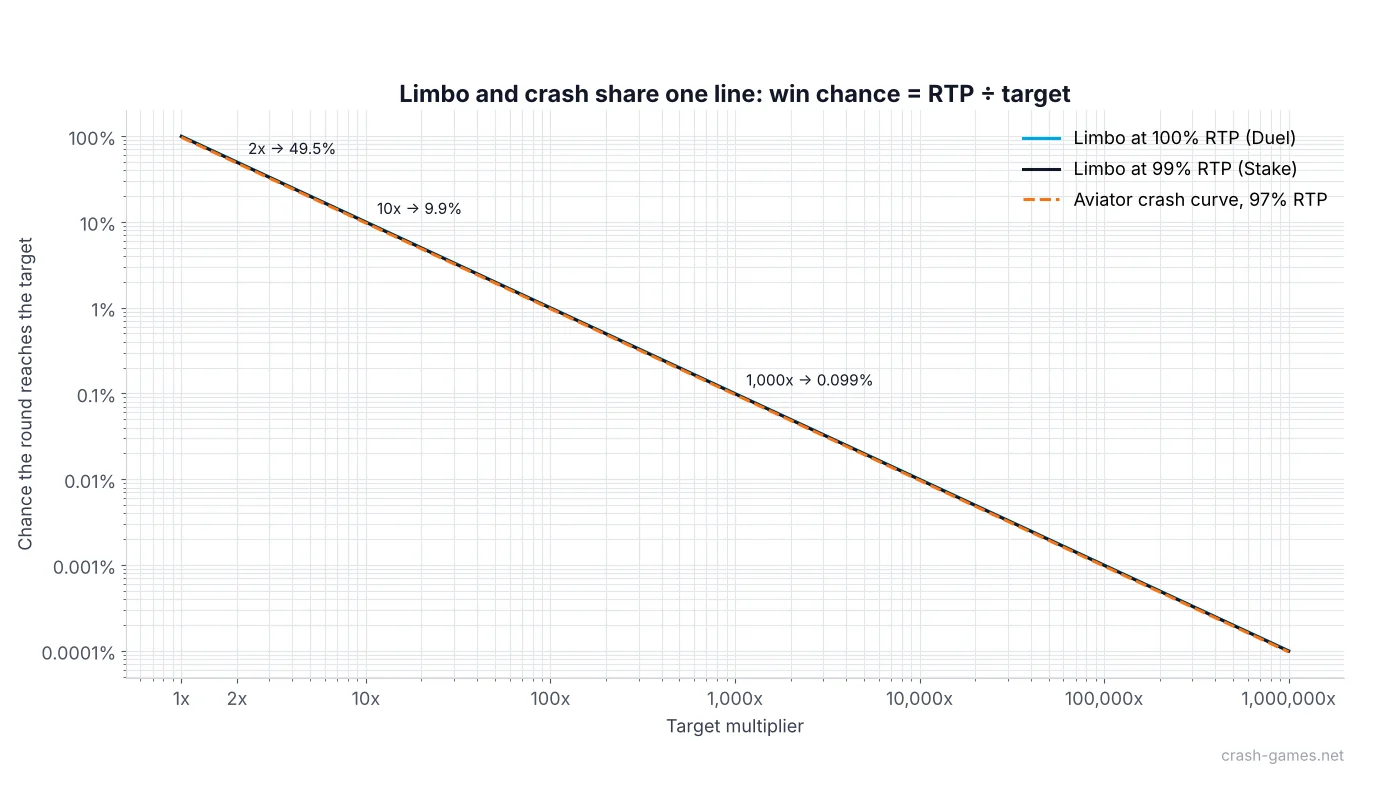
If the game pays the target when you win, and the game returns the RTP on average, then the win chance has to be the RTP divided by the target. Nothing else balances. Target 2x at 99% RTP: 49.5%. Target 10x: 9.9%. Target 1,000x: 0.099%, one round in 1,010. At Duel’s 100% the figures are 50%, 10% and 0.1% exactly.
| Target | Win chance at 100% | Win chance at 99% | Average rounds per win (99%) |
|---|---|---|---|
| 1.01x | 99.01% | 98.02% | 1.02 |
| 1.10x | 90.91% | 90.00% | 1.11 |
| 1.50x | 66.67% | 66.00% | 1.52 |
| 2x | 50.00% | 49.50% | 2.02 |
| 3x | 33.33% | 33.00% | 3.03 |
| 5x | 20.00% | 19.80% | 5.05 |
| 10x | 10.00% | 9.90% | 10.1 |
| 20x | 5.00% | 4.95% | 20.2 |
| 50x | 2.00% | 1.98% | 50.5 |
| 100x | 1.00% | 0.99% | 101 |
| 1,000x | 0.10% | 0.099% | 1,010 |
| 10,000x | 0.01% | 0.0099% | 10,101 |
| 1,000,000x | 0.0001% | 0.000099% | 1,010,101 |
The right-hand column is the one to read before setting a high target. “Average rounds per win” is an average, not a promise: at 1,000x the chance of going 1,000 rounds without a single hit is 0.999011000 ≈ 37%. More than a third of players who budget “a thousand tries” for a 1,000x will see none, and the expected cost of those thousand tries at 99% is ten stakes whether the hit comes or not.
Limbo is a crash game without the animation
A crash game draws a crash point each round and pays anyone who cashed out below it. If the game returns the RTP, the chance that the crash point is at least T has to be RTP ÷ T: the same line as the table above. Aviator’s 97% RTP means the plane reaches 2x on 48.5% of rounds and 10x on 9.7%; Stake’s Crash at 99% reaches them on 49.5% and 9.9%; Limbo at 99% pays 2x on 49.5% of rounds and 10x on 9.9%.
The differences are presentation, and they matter for behaviour rather than value:
- Timing. In crash you can change your mind mid-round, which is where most of the tilt described on the near-miss page comes from. In Limbo the decision is locked before the draw, so the only mistake available is the target itself.
- Auto-cashout is the same thing. A crash round with auto-cashout set at 3x is a Limbo bet on 3x with a longer animation. The auto-cashout page makes the case for pre-committing in crash; Limbo simply removes the alternative.
- Speed. Limbo resolves instantly and has an autobet; a crash round takes as long as the curve takes to climb. Per hour, Limbo turns the bankroll over many more times at the same price per unit.
- Multiplayer. Crash shows you other players cashing out; Limbo shows you a number. The social layer is where “everyone cashed out at 1.5x” and other pattern illusions live.
For the crash games themselves, the Aviator, JetX and Spaceman comparison covers each game’s RTP and auto-cashout tools.
Provably fair: one number, inverted
At Duel and Stake the result is computed before the round from the server seed (committed by hash), your client seed and a bet nonce. HMAC-SHA256 produces a number between 0 and 1; the result is, in essence, the RTP divided by that number, floored to two decimals and never below 1.00x. Small numbers produce large results, which is why the table above is a straight line on a logarithmic chart: the chance of a result of at least T is the chance that the random number is at most RTP ÷ T. No “Limbo predictor” can know the number before the server seed is revealed, and the seed is revealed only after you rotate it. The provably fair guide shows the verification; the predictor-app page covers the pitch.
A strategy framework that respects the maths
- Choose the target by win frequency, then leave it. 1.5x wins two rounds in three; 2x wins half; 5x wins one in five; 20x wins one in twenty. The price per unit wagered is identical at every target: 0.01 at 99%, zero at 100%.
- A high target is a lottery ticket with a known price. Hunting 1,000x costs an expected 1% of everything wagered at Stake and nothing at Duel; the hit itself arrives on average every 1,010 rounds and may not arrive in 1,000. Decide whether the ticket is worth the turnover before the first bet, not after the 800th.
- Streak maths is the bankroll maths. At 2x, ten consecutive losses have probability 0.50510 ≈ 0.11%, which is routine over a long autobet. At 5x, ten losses in a row have probability 0.80210 ≈ 11%. The bankroll guide covers sizing.
- Progressions change the shape, not the sum. Doubling after a loss, raising the target after a win, “two-bet splits” and every other scheme have expected value equal to the house edge times total turnover. The two-bet split page explains why the split can still be worth running for its variance profile.
- Prefer the higher printed RTP. The same 2x target wins 50% of rounds at Duel and 49.5% at Stake. That half a percent is the entire difference between the two games.
Where to play Limbo
Duel’s Limbo carries the 100% RTP badge of its Originals range; Stake’s is the 99% reference version. Each operator’s restrictions are on the where-to-play page.
| Casino | Version | RTP shown | Play |
|---|---|---|---|
| Duel | Duel Originals | 100% | Open Duel Limbo |
Availability, currency and bet limits depend on your jurisdiction and on each operator’s own rules.
FAQ
What is the RTP of Limbo?
100% at Duel and 99% at Stake, as published by each. It is the same at every target, because the win chance is always the RTP divided by the target multiplier.
What is the best Limbo target?
There is no best target for expected value. Low targets win often and pay little; high targets win rarely and pay a lot; the average return per unit is identical. Choose by how often you want to win, and by the losing streak that frequency implies.
Is Limbo the same as a crash game?
Mathematically, yes. A crash game’s chance of reaching a multiplier T is its RTP divided by T, which is Limbo’s win chance for target T. Limbo removes the animation, the mid-round cashout and the other players; the price per unit is the same.
How often does Limbo hit 1,000x?
Once per 1,010 rounds on average at 99% RTP, once per 1,000 at 100%. Over 1,000 rounds the chance of seeing no 1,000x at all is about 37%.
Can a Limbo predictor know the next result?
No. The result is computed from a server seed the casino committed to before the round, your client seed and a bet counter. The server seed is revealed only after rotation, so no outside app can compute the result in advance.
Play responsibly
Limbo resolves instantly and its autobet will place rounds faster than you can read the results. Set a deposit and time limit before you start, never chase a loss, and stop when the session stops being fun. Play only if you are 18+ and gambling is legal where you are.
Free, confidential advice and self-exclusion tools are available at BeGambleAware.