
Crash games look simple on the surface — a multiplier goes up, you cash out or you do not. But underneath that simplicity are mechanics that directly affect your experience: RTP determines how much the house keeps over time, volatility shapes how wild your sessions feel, and provably fair lets you check whether a round was legitimate.
Most casino sites bury this information in small print or skip it entirely. We think players deserve better than that. Every guide in this section is written in plain language for people who want to understand what is actually happening when they play — without the jargon.
Available Guides
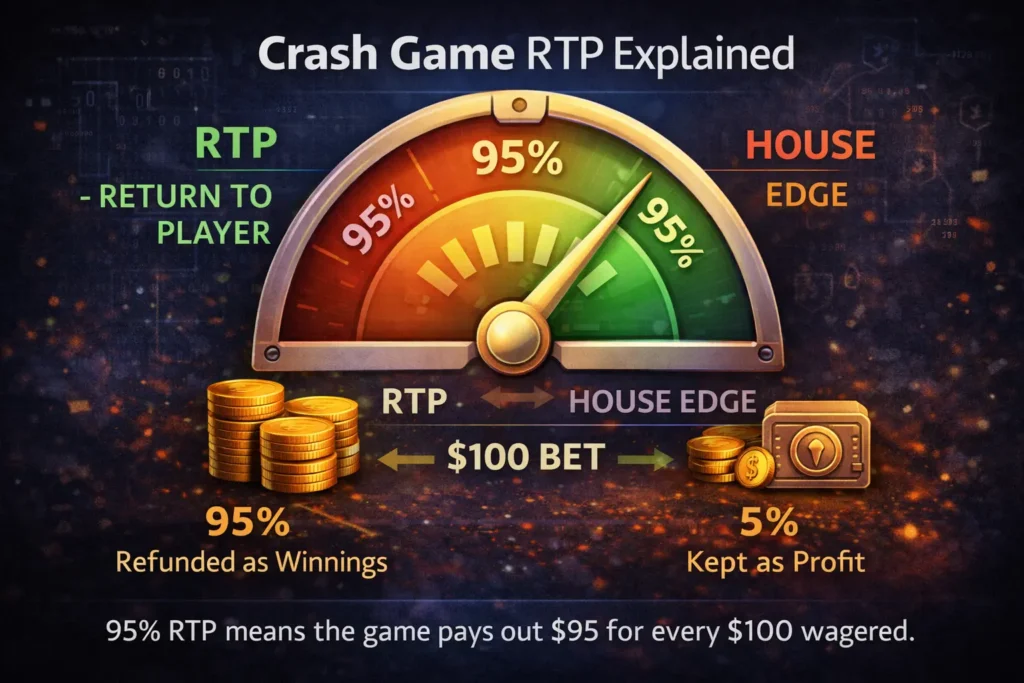
RTP Explained — RTP stands for Return to Player, and it tells you the theoretical percentage of bets a game pays back over a very large number of rounds. A crash game with 97% RTP means, on average, $3 out of every $100 wagered goes to the house. But “on average” does not mean “every session” — and that is the part most people misunderstand.
Volatility Explained — Two games can have the same RTP but feel completely different. One might pay small amounts frequently, while another pays rarely but in larger chunks. Volatility describes that difference, and it matters a lot more for your session experience than most players realize — especially in crash games, which tend to sit on the high end.
Provably Fair Verification — Many crash games — especially at crypto casinos — use provably fair technology. This means you can mathematically verify that the crash point for each round was determined before the round started and was not manipulated. Our guide walks you through the verification process step by step, with real examples.
Responsible Gambling — Crash games are designed to be fast and engaging, which also makes them high-risk for players who struggle with limits. This guide covers practical tools: session budgets, time limits, self-exclusion options, warning signs that play has become unhealthy, and where to find support if you need it.
Who These Guides Are For
You do not need a math degree or a gambling background. These guides are written for anyone who plays crash games — or is thinking about it — and wants to make informed decisions. Whether you have played a thousand rounds or zero, starting here will save you confusion (and possibly money) later.

If you are completely new, start with Provably Fair Verification — it is the most important trust concept in crash gaming. Then move to Responsible Gambling before you play for real money.
Quick Glossary
- Multiplier — The number that rises during a crash game round. Cash out before the crash to win your bet times the multiplier.
- Auto-cashout — A setting that automatically cashes you out when the multiplier hits your chosen target.
- House edge — The percentage of every bet the casino keeps on average over time. Typically 1% to 5% in crash games.
- Provably fair — A cryptographic system that lets players verify each round was not manipulated.
- Variance — The natural ups and downs of short-term results around the long-term average (RTP).
- Session limit — A pre-set budget or time restriction you set before playing to avoid overspending.
Crash games are high-volatility and outcomes are random. Understanding these mechanics will not change the odds — but it will help you make better decisions about how, when, and whether to play.
 English
  Português do Brasil
  Español
  Türkçe
  हिन्दी
  Русский
  Polski
  Bahasa Indonesia
  Tiếng Việt
  العربية
  Қазақ тілі
  Deutsch
  Français
  Latviešu valoda